WA Week Eight – June 30 – July 6
How shall I say it…we saved the best for last? I’m not sure; you decide…we loved every minute.
We heard so much about Coral Bay that we added this spot to check it out. Everywhere everyone south of and around Perth raved about this part of WA. Now that I consider it, the fact is it was becoming colder in the south and everyone was green with envy that we were going to the “tropics”.
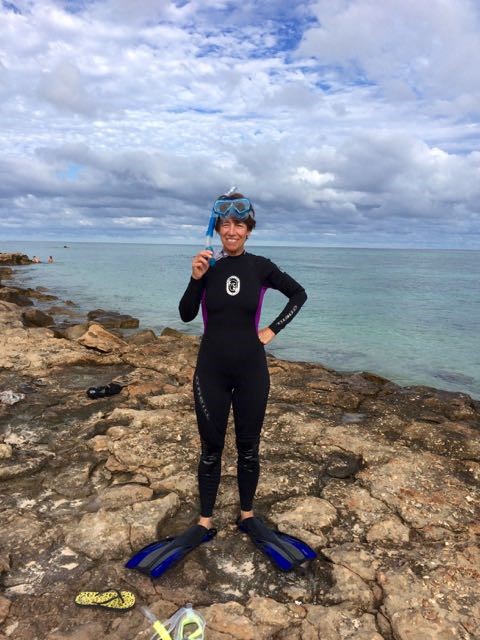
Turns out Coral Bay it is a tiny, arid, coastal hamlet that enjoys a fringing reef just off the beach so it’s a snorkelers paradise for families. The town consists of 2 caravan parks, a general store, a dive shop, a bunch of tour operators and 5 restaurants. Population 190 in summer, and 1,100 in winter (but don’t quote me). It has a poor man’s Key West vibe on a minuscule scale and without the humidity (a definite plus!). We arrived in time to buy fins, mask & snorkel for each of us. The next day we got some local scoop on the snorkel scene, then ended up taking a glass bottom boat (I can hardly believe it…me on a glass-bottom boat!) out to the reef where we paddled around a predominately colourless reef with a variety of more colourful fish. But the tide was receding and it became an effort to manoeuvre through the coral heads without getting scratched and paying heed to the fish was secondary. Turns out the best swimming was right next to the boat where schools of snapper were hanging out expecting a feed it seemed.

Our last few days on the coast were spent in Cape Range NP, latitude 22 degrees south. The Ningaloo Reef becomes a Marine Sanctuary here and it is the big draw. We could have paid $385 to swim with the whale sharks, but we couldn’t help but think that was a bit excessive. Instead we opted to snorkel from the beach at Oyster Stacks and Turquoise Bay which didn’t disappoint.
The reef again was pretty colorless but the fish certainly weren’t. There were great schools of parrotfish, wrasse, angelfish, clownfish, scissor tails, butterfly fish, iridescent clams, starfish and countless others. But the real star was a loggerhead turtle, a graceful creature that we followed in circles for ages. Then I was surprised to catch a glimpse of something startling. I called out to Joe to confirm my suspicions and as we stared in the rocks below, we saw the churning of an octopus. It was a master at camouflage but when it chose to move there was no mistaking those lovely long legs. We were enthralled. I don’t have a camera suitable for underwater photos but next time I will be sure to have one.

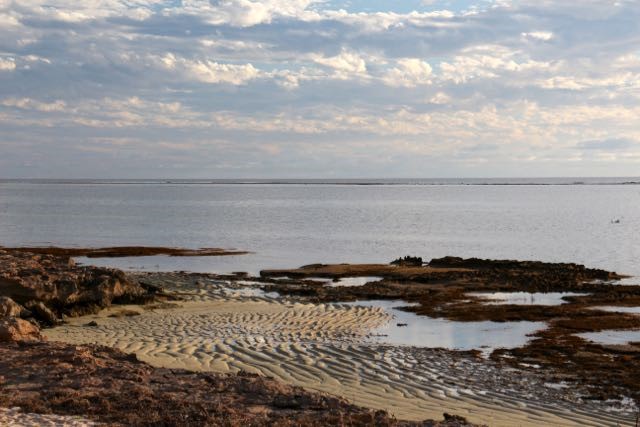
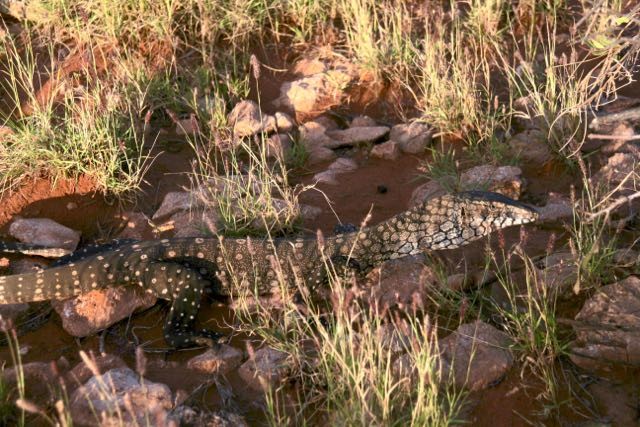
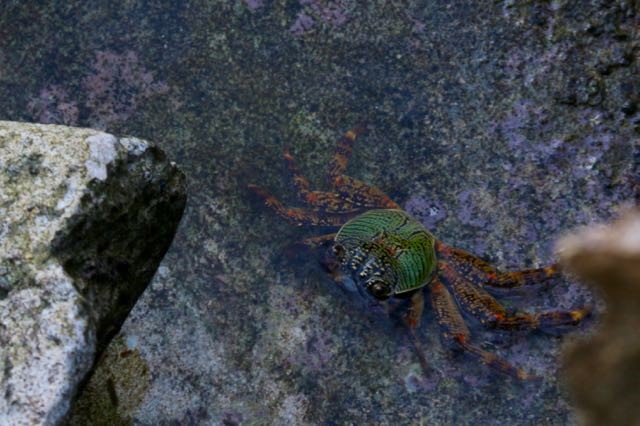
Cape Range wasn’t just about the water. The frontier-like “range” that follows the coast and separated us by 100 kilometers from fresh water, fuel, groceries and cell service is also home to a couple small gorges, one dry and one wet at the time we visited. These offered us short but rugged hikes and wildlife. There are two kinds of wallaby in these parts: the rock wallaby hangs out on the steep ledges of the gorges and sports a few skunk-like features and a long black tail; the euro is actually a wallaroo which is between a kangaroo and wallaby in size. The euro seemed to travel quickly on a more lateral level rather than a hop. We saw 56 of these in pairs on the main road as we departed Cape Range before sunrise. They wouldn’t move until the last second as our van approached. One pair stared at us and as we stared back, they began to move in opposite directions, stopped, then in a flash began boxing, really, boxing for just a moment, then took off the same direction. It was almost as though they had a little spat about which direction to go. I snatched up my camera but couldn’t capture this startling event so you’ll have to take my word for it. We also saw wild emus and a rare species of lizard called a Parentie, which took up half the road as it scurried across. Joe managed to find it in the bush and captured a beautiful photo of it.

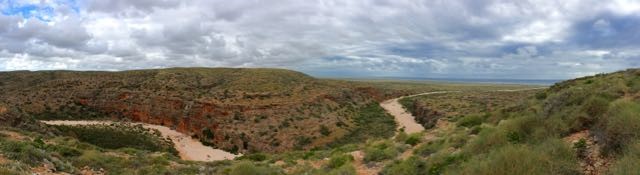

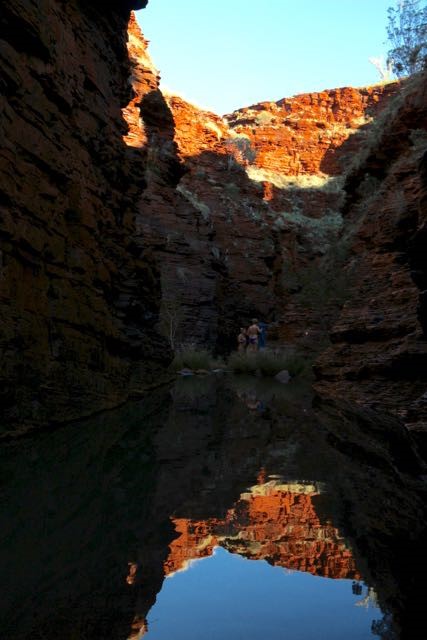
We had a lot of driving to do in the last week and it was worth it. The magnificent Karijini NP is inland about 700 kms from the coast. We barely made it there on a tank of diesel and I didn’t notice any gas stations the whole time. The rugged mountainous landscape rises only to 1,200 metres. But within them are hidden the dramatic dark chasms of five gorges. Granted, these are not of “Grand Canyon” scale, but they are every bit as impressive in their solitude and intrigue. The rock is iron ore that has been upthrust, twisted and carved into pancake like ledges over the years and is as red as rust can get. The gorges become quite narrow in spots – one section is known as Spiderman walk since you have to work your way through it gripping the sides of the walls.
Our timing was perfect as a lot of the gorges were still walkable, but we did have to do a fair bit of rock hopping, then wading, then swimming to explore the most spectacular sections. After plenty of chats with other hikers/waders/swimmers I didn’t take any chances. I left my camera stowed safely, wore my sneakers, and carried a walking stick, but couldn’t resist clipping my iPhone to the neckline of my suit. Eventually I left even it behind when I saw that I would have to submerge totally. We had to climb a few strategically placed “ladders” in order to scale walls so we could swim under warm waterfalls. We felt as giddy as sixty-something thrill-seekers can feel.
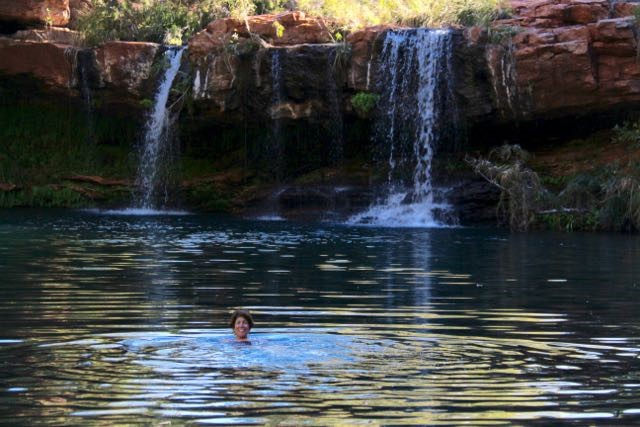



And again ***The following photo was NOT taken by either of us**** (Damn!)
I’m not sure which pool this is but surely if I had had my camera with me, I could have captured this image. I just gotta take more risks! Again…***this photo was NOT take by either of us***